Product discovery
When a Character Becomes a Product
How people identifying with a game character led me to explore a small, useful everyday timer.
In early reactions to Somewhere Together, people identified with Tuft, the character they were playing. They described themselves as cute, rather than just commenting on the character's appearance.
That was a small observation with an interesting product question behind it. Could Tuft give a familiar everyday activity a more personal presentation?
Somewhere Together is my first game-development project. I came to it with experience in technical innovation and product work, and AI has helped me build and explore it. The character response gave me a reason to look beyond the game. It did not tell me which product to make.
Follow the observation without turning it into demand
It would be easy to take an enthusiastic reaction and jump straight to a product line. But liking a character in a game leaves several questions open. Would someone want that character in a utility? Would the utility be useful without knowing the game? Would they come back when the novelty wore off?
I had an observation about identification. I did not have evidence of retention, sales or demand for a separate app.
The next step needed to make one of those questions easier to examine. A small product could put Tuft into a real task and let me see whether the combination was worth developing further.
Choose an everyday job the character can accompany
I was interested in simple everyday interactions rather than building another agent. A timer offered a concrete starting point: choose a duration, start it, pause if needed and know when the time is up.
Tea, cooking, laundry and a stretch of focused work can all use that basic interaction. They do not need separate product modes to establish that a countdown is useful. The current development version has one general timer, with reusable names and durations. A saved timer gives a repeated activity a familiar place to start.
Tuft's journey gives elapsed time a visual expression. The character travels while the timer runs, pauses when the session pauses and reaches the destination at completion. That relationship gives the presentation a job: it helps express the activity's progress.
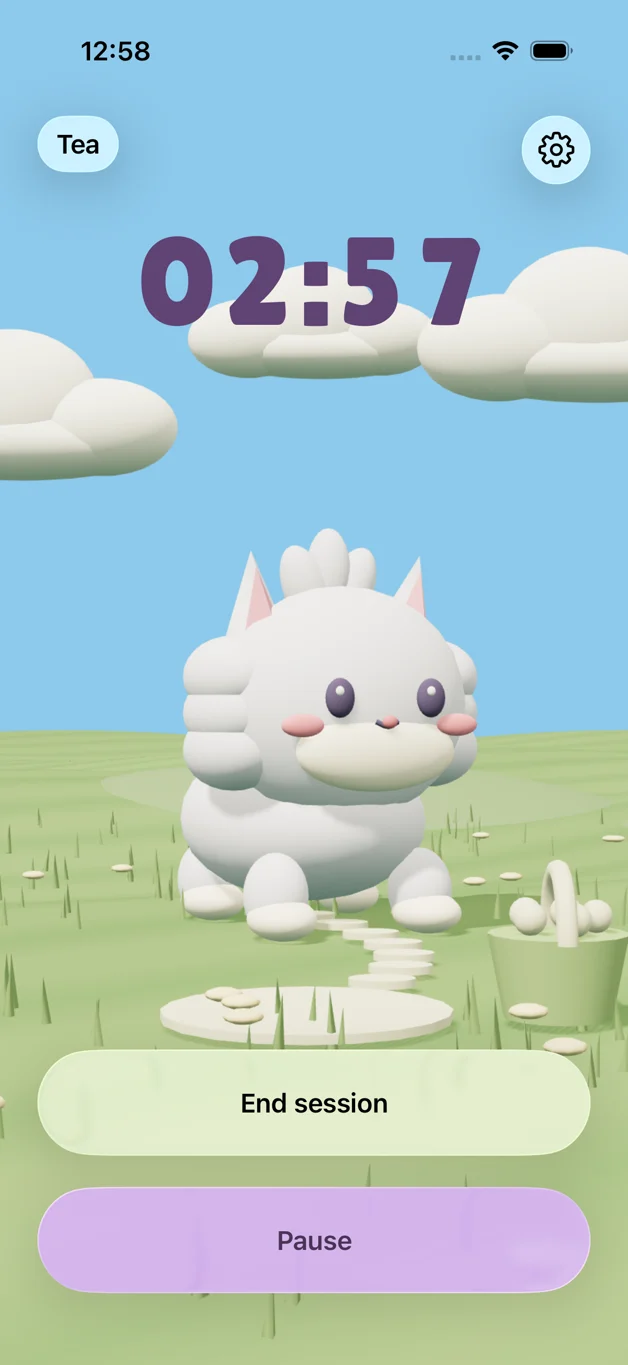
The main screen still needs to answer ordinary questions quickly. How much time is left? Is it running? Where is Pause? A character cannot compensate for unclear controls.
Let the native timer own time
The most important product boundary is easy to miss in a screenshot. The character presents the session; native app state owns its timing and recovery.
A scene can render slowly or stop drawing when the app is interrupted. Counting animation frames would make the timer depend on the wrong system. In Tuft Timer, the native session supplies the time and progress that the scene displays. Native platform adapters handle the relevant system alerts.
That separation also makes the character's behavior easier to reason about. Pause freezes the journey because the session is paused. Completion reaches the destination because the session has finished. The artwork follows the tool's state.
This is development work with remaining reliability checks. A successful simulator run, a device installation and dependable alerts across interruption, reboot and long use are different kinds of evidence. The character presentation does not close those gaps.
Keep the warmth in the interaction
A character-led product does not need a sentence of encouragement attached to every action. Tuft can carry personality through appearance, movement and a small response to interaction. The controls can use direct labels.
That keeps attention on the task. Someone opening a timer should be able to start it without learning a story or holding a conversation. Reusable names and journeys can add familiarity while the core action stays small.
This is the part I want to keep testing: how much expression helps, and where it begins to get in the way. More animation or more personality is not automatically a better timer.
Ask for evidence from ordinary use
The next product question is whether someone chooses to use it again for an actual activity. I would want to observe people who already know Tuft and people encountering the character for the first time. Those groups can help separate familiarity with the game from the utility's own appeal.
I would look for where they hesitate, whether they can recover from interruptions and whether saved activities make a repeat session easier. Those observations would inform what to simplify before expanding the product.
Tuft Timer is still in development. The early character reaction gave me a direction to explore, and the timer gave that direction a concrete form. The next decision depends on whether the useful task and the character continue to work well together in everyday use.